Best Disc Golf Rangefinder: Top Picks for Distance and Slope in 2026

Quick Comparison
| Product | Best For | Price |
|---|---|---|
Disc golfers who want elevation reads in feet and an instrument tuned for chain baskets | Check Price | |
Disc golfers who want disc-golf-aware features without the Bushnell price | Check Price | |
Players who want a proven mid-range rangefinder with slope at a reasonable price | Check Price | |
Players who want premium optics from an actual optics company | Check Price | |
Players who want a slope toggle for tournament-legal use plus OLED display | Check Price |


Disc golfers who want elevation reads in feet and an instrument tuned for chain baskets
Check Price on AmazonDisc golfers who want disc-golf-aware features without the Bushnell price
Check Price on AmazonPlayers who want a proven mid-range rangefinder with slope at a reasonable price
Check Price on AmazonPlayers who want premium optics from an actual optics company
Check Price on AmazonPlayers who want a slope toggle for tournament-legal use plus OLED display
Check Price on AmazonA rangefinder is the gear most disc golfers do not realize they need until the first time they use one. Knowing the exact distance to the basket - 287 feet vs the 240 you guessed - changes which disc you pull, how hard you throw, and how often you hit your line. For longer holes especially, you stop guessing and start playing the actual yardage.
The catch: most rangefinders on the market are designed for ball golf, where the target is a flag in an open fairway. Disc golf targets are chain baskets often hidden behind trees, with elevation changes and harder lock-ons. The rangefinders that work best for disc golf either are purpose-built for the sport (rare) or have features that translate well from ball golf to wooded courses.
This guide covers the rangefinders worth buying in 2026, from a purpose-built disc golf laser to budget picks under $100, plus what to look for and whether you actually need one at all.
Quick Picks: Best Disc Golf Rangefinders at a Glance
- Best Overall: Bushnell Edge Disc Golf Rangefinder - the only mainstream rangefinder built specifically for disc golf, with elevation reads in feet
- Best for Disc Golfers on a Budget: Gogogo Sport Vpro Disc Golf - 2500-yard range with slope and disc-golf-tuned ZeroIn mode
- Best Mid-Range: TecTecTec VPRO500S - 540 yards, slope, pin lock, the best value pick under $200
- Best Premium: Nikon Coolshot 20 GII - cleaner optics, faster lock-ons, made by an actual optics company
- Best Versatile (Tournament + Casual): Gogogo Sport Vpro Gen 2 - slope toggle plus OLED display
Do You Actually Need a Rangefinder for Disc Golf?
Short answer: no. You can play disc golf forever without one, just like ball golfers played for centuries with no rangefinders. But there are real benefits, and the cost has come down enough that most serious players eventually buy one.
You probably want a rangefinder if:
- You play unfamiliar courses regularly. Knowing the actual distance saves strokes when you don't have feel for a hole.
- You play tournaments. Yardage information helps with disc selection and shot planning.
- You are working on distance training. A rangefinder lets you measure how far you actually throw a given disc, which is the foundation of building accurate distance feel.
- You play long courses with elevation changes. A rangefinder with slope tells you what the disc will actually have to fly, not just the horizontal distance.
You probably do not need a rangefinder if:
- You play the same one or two home courses where you already know every hole length.
- You are casual and not chasing a lower score.
- You use UDisc for course maps and the listed distances are accurate.
Dedicated Disc Golf Rangefinders vs Ball Golf Rangefinders
There is exactly one mainstream rangefinder marketed specifically for disc golf - the Bushnell Edge - and dozens of ball golf rangefinders that work fine on a disc golf course.
Ball golf rangefinders are designed to lock onto a flag at 100 to 250 yards in an open fairway. Disc golf rangefinders need to lock onto a basket (smaller target) often partially obscured by trees, with mostly shorter distances (under 200 yards).
The features that matter most for disc golf:
- Pin lock / target priority. When you aim through trees, the rangefinder needs to ignore the closer trees and find the basket behind them. Most modern rangefinders have a "first target" or "pin priority" mode that handles this.
- Slope / elevation. Disc golf has more elevation than most ball golf - shots thrown 30 feet uphill or downhill are common. A rangefinder with slope tells you the adjusted distance.
- Compact size. You will be carrying this for 18 holes alongside your bag. Lighter and smaller is better.
- Reasonable range. Anything that reaches 400+ yards is more than enough for disc golf. You rarely need 1,000+ yard range.
- Battery life. A typical disc golf rangefinder uses a CR2 battery and lasts months. Some newer models have rechargeable batteries.
Slope is allowed in casual disc golf and prohibited in PDGA tournaments. If you play tournaments, look for a rangefinder with a slope toggle so you can disable it for legal use.
The Best Disc Golf Rangefinders Reviewed
Bushnell Edge Disc Golf Rangefinder
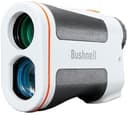
Bushnell Edge Disc Golf Laser Rangefinder
Disc golfers who want elevation reads in feet and an instrument tuned for chain baskets
Pros
- Purpose-built for disc golf with feet-based readouts
- Z-Mode elevation reading in feet
- 6x magnification with brighter optics
- Lifetime Ironclad warranty
Cons
- Pricier than budget ball golf alternatives
- Larger than ultra-compact rangefinders
- IPX4 is splash-proof, not fully waterproof
The Bushnell Edge is the only mainstream rangefinder purpose-built for disc golf, and it is what most serious disc golfers eventually buy. The differences from a standard ball golf rangefinder are subtle but meaningful: distances display in feet rather than yards, the Z-Mode reads elevation in feet, and the optics are tuned for finding basket-sized targets in wooded environments rather than flags in open fairways.
The 6x magnification with a 24mm objective lens gives you a brighter image than smaller-objective rangefinders, which matters on shaded wooded courses where you are trying to pick out a basket through tree branches. The accuracy of +/- 3 feet is more than enough for disc golf - you do not need 1-yard precision when your throws have 20-foot variance.
One-button operation is the right call for disc golf. You are already managing a bag, a disc, and your throwing routine. Press once to power, press again to range. No menu diving, no mode switching mid-round. The Lifetime Ironclad warranty is a real differentiator at this price.
The trade-off vs cheaper rangefinders is the price - the Edge runs around $100 vs $50 to $80 for budget alternatives. If you want a single rangefinder that you do not have to think about, this is the one.
Gogogo Sport Vpro Disc Golf Rangefinder
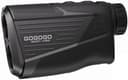
Gogogo Sport Vpro Golf Hunting Range Finder 2500 Yards
Disc golfers who want disc-golf-aware features without the Bushnell price
Pros
- ZeroIn disc golf mode for finding baskets through trees
- Long range and slope mode included
- Rechargeable battery
- Strong value at the price point
Cons
- Plastic build feels less premium
- Optics not as crisp as Nikon or Bushnell
- Brand recognition is lower than the legacy names
Gogogo's lineup of budget rangefinders has gotten serious in the last two years, and the 2500-yard model with the ZeroIn disc golf mode is the standout for the disc community. ZeroIn mode is essentially a target-priority mode tuned for catching baskets through tree gaps - the rangefinder ignores closer obstructions and locks onto whatever is behind them, which is exactly what you need on a wooded fairway.
The 2500-yard total range is overkill for disc golf, but the long-range capability comes with better optics and a more sensitive sensor than entry-level units. Slope mode is included with a toggle for tournament-legal play. The magnetic mount lets you stick it to a metal cart or bag clip.
The build is plastic and feels less premium than the Bushnell Edge or Nikon options, but the rangefinder works well and Gogogo's customer service has improved a lot. Rechargeable battery is a nice touch if you hate buying CR2 cells.
TecTecTec VPRO500S
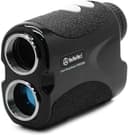
TecTecTec VPRO500S Laser Golf Rangefinder
Players who want a proven mid-range rangefinder with slope at a reasonable price
Pros
- Reliable optics and build quality
- Strong pin lock with vibration feedback
- Slope mode included
- Excellent customer support and warranty
Cons
- Not tuned specifically for disc golf
- Less value at the price compared to Gogogo
- CR2 battery (some prefer rechargeable)
The TecTecTec VPRO500S is one of the most reviewed rangefinders on Amazon, and most of those reviews are positive for good reason. The optics are noticeably better than budget brands, the pin lock with vibration confirmation is responsive, and the slope mode adds enough utility to justify the price bump over base TecTecTec models.
For disc golf use, the 540-yard range is more than sufficient - you rarely need to range a target more than 200 yards away on any course. The 6x magnification matches the Bushnell Edge. The build feels more substantial than the Gogogo Sport Vpro and is closer in quality to Nikon's entry-level rangefinders.
The main weakness for disc golf specifically is that it does not have a disc-golf-specific target mode - the pin lock is tuned for golf flags. In practice it still works for baskets, but you might need to scan a few times to get a clean read in heavily wooded conditions.
Nikon Coolshot 20 GII
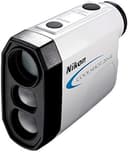
Nikon Coolshot 20 GII Golf Laser Rangefinder
Players who want premium optics from an actual optics company
Pros
- Premium optics with real Nikon lens quality
- Compact and lightweight
- Fast First Target Priority lock-on
- Reliable, well-built
Cons
- No slope mode (in this version)
- Yards only, no feet readout
- Higher price than budget alternatives
Nikon has been making lenses for over 100 years, and that lineage shows up in the Coolshot 20 GII. The optical clarity is noticeably better than any budget rangefinder - you see colors more accurately, the image is brighter at the edges, and the lock-on is faster because the target image is clearer.
The First Target Priority feature is essentially Nikon's version of pin lock, and it works well for finding chain baskets through tree gaps. The compact size (smaller than the Bushnell Edge) makes it easier to carry, and the weather resistance covers normal rainy-round use.
The trade-off vs the Bushnell Edge: no slope mode, no disc-golf-specific elevation readout, and yards instead of feet. For tournament players who can't use slope anyway, that is not a meaningful loss. For casual players who want elevation help, the Bushnell wins.
Gogogo Sport Vpro Gen 2
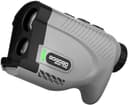
Gogogo Sport Vpro Gen 2 Golf Laser Rangefinder
Players who want a slope toggle for tournament-legal use plus OLED display
Pros
- OLED display works in low light
- Dual power source (rechargeable or AAA)
- Slope toggle for tournament play
- Strong value under $120
Cons
- Optics not at Nikon premium level
- No disc-golf-specific target mode
- Plastic build
The Gen 2 of Gogogo's flagship rangefinder upgrades the display to OLED, which is a real improvement in low-light conditions like dawn rounds or shaded wooded fairways. The dual power system lets you charge via USB or fall back to two AAA batteries if you forget to charge before a round - a nice failsafe.
For disc golfers who play tournaments, the slope toggle is important. PDGA rules prohibit slope-adjusted distances during sanctioned play, so being able to disable slope without buying a different rangefinder matters. The Gen 2 has a clear external slope switch you can verify visually.
Optics are good for the price but not at the Nikon level. The lock-on is solid for chain baskets in moderately wooded conditions. Build quality is plastic but feels reasonably solid.
How to Choose the Right Rangefinder for Disc Golf
Decide Whether You Want Slope
Slope adjusts the distance reading based on elevation - a 250-foot uphill shot might play like 280 feet, and the rangefinder will tell you that. It is genuinely useful for disc golf because elevation is a constant factor on most courses.
But slope is illegal in PDGA tournaments. If you play sanctioned tournaments, get a rangefinder with a slope toggle (Gogogo Gen 2, TecTecTec VPRO500S) so you can use slope casually and disable it for events. If you only play casual rounds, slope is a clear win.
Match Range to Course Length
You almost never need more than 600 feet of range for disc golf. The longest disc golf holes in the world top out around 1,500 feet, and you do not need to range the full hole - you range from your lie, which is usually 200 to 400 feet from the basket. Anything advertising 1,000+ yard range is overkill but does not hurt.
Optics Matter More Than You Think
A clear, bright image makes all the difference when you are trying to find a chain basket through tree branches. Cheap optics produce dim, color-shifted images that are hard to focus through. The Nikon Coolshot 20 GII and Bushnell Edge both have noticeably better optics than sub-$100 alternatives. If you value clarity, spend the extra $50.
Battery Type
Most rangefinders use CR2 batteries that last 3+ months of regular play. Newer models offer rechargeable batteries via USB. CR2 has the advantage of being available everywhere; rechargeable has the advantage of not having to buy batteries. The Gogogo Gen 2 supports both.
Size and Weight
Carry a rangefinder for 18 holes alongside your bag, and the size starts to matter. Compact units like the Nikon Coolshot 20 GII fit in any pocket or bag pouch. Larger ones like the Bushnell Edge are still portable but bulkier. Weight differences are usually small - most rangefinders are between 6 and 10 ounces.
Apps as an Alternative: UDisc
Before you spend $80+ on a rangefinder, consider whether a free or cheap app handles your needs. UDisc is the dominant disc golf app and includes course maps, GPS distance to the basket, and detailed hole information. For most casual disc golfers playing established courses, UDisc tells you the same distance information a rangefinder would.
UDisc strengths:
- Free version works on most courses
- Pre-mapped courses with accurate hole distances
- GPS-based, so no aiming required
- Shows distance to the basket from your current position
Where a laser rangefinder beats UDisc:
- Unmapped courses (newer or remote courses might not be in UDisc)
- Specific lie measurement (UDisc uses GPS, which is +/- 10 feet accurate)
- Distance to a specific tree or obstacle, not just the basket
- Practice and training (measuring exact disc throw distances)
For most casual rounds, UDisc is enough. For tournament-level practice, course design, or unfamiliar courses, a laser rangefinder pays off.
Common Mistakes With Rangefinders
Mistake 1: Trusting Slope on Steep Courses
Slope is calculated from a small angle measurement. On steep elevation changes, that angle is more sensitive to small variations. A rangefinder might read a 15% slope when the actual playing slope is 12%, leading to a slightly wrong adjusted distance. Use slope as a guide, not a precise number.
Mistake 2: Ranging the Wrong Target
Aiming at a tree in front of the basket and assuming you have ranged the basket. Most rangefinders with pin lock or first-target priority handle this, but not all do, and not every read is clean. Always verify the number against your eye estimate. If a 250-foot hole reads as 187 feet, you probably hit a tree.
Mistake 3: Buying Too Much Range
A 2500-yard rangefinder is impressive on the box but overkill for disc golf. Range capability beyond 600 yards adds cost without benefit for our sport. Better to spend that money on optics quality or a slope toggle.
Mistake 4: Forgetting to Toggle Slope Off in Tournaments
Slope-on during a PDGA tournament is a rules violation. If your rangefinder doesn't have an external visual indicator that slope is off, double-check before each tournament round. Some players cover the slope toggle with tape during events as a reminder.
Frequently Asked Questions
Do I need a special disc golf rangefinder, or can I use a ball golf rangefinder?
A standard ball golf rangefinder works fine for disc golf. The Bushnell Edge is the only mainstream rangefinder marketed specifically for disc golf, and its main differentiators are feet-based readouts and elevation in feet. If you can do mental math on yards-to-feet, any quality ball golf rangefinder will work.
Are slope rangefinders legal in PDGA tournaments?
Slope-adjusted distances are not legal during PDGA-sanctioned tournament play. You can use a rangefinder with slope, but the slope feature must be disabled. Many rangefinders have an external toggle so you can enable slope for casual rounds and disable it for tournaments.
What is a good budget for a disc golf rangefinder?
The sweet spot for disc golf is $80 to $150. Below $80 you start to see compromised optics and build quality. Above $200 you are paying for premium optics or features that may not significantly improve your disc golf experience. The Bushnell Edge at $100 is a strong "no thinking required" pick.
Can I use my phone instead of a rangefinder?
Yes, with limitations. The UDisc app provides GPS-based distance to the basket on most established courses. It is accurate to about 10 feet, which is fine for casual play. A laser rangefinder is more precise and works on courses UDisc doesn't have mapped.
How accurate are disc golf rangefinders?
Quality rangefinders are accurate to +/- 1 to 3 feet on disc-golf-relevant distances (under 600 feet). The Bushnell Edge specifies +/- 3 feet, the TecTecTec VPRO500S specifies +/- 1 yard. For disc golf purposes, anything within +/- 5 feet is more than precise enough.
What is "pin lock" or "first target priority"?
These features tell the rangefinder to lock onto the first reflective object in your aim, ignoring background objects. This is what catches a flag in front of trees in ball golf, or a chain basket in front of a treeline in disc golf. It is essential for wooded course conditions.
How long does the battery last?
Most rangefinders with CR2 batteries last 3 to 6 months of regular play (a few rounds per week). Rechargeable models last about 6 hours of active use per charge. Plan to replace or recharge before tournaments.
Final Thoughts
A rangefinder is one of those upgrades that changes how you think about a round of disc golf. Once you stop guessing distances and start playing the actual numbers, your disc selection sharpens, your throws become more deliberate, and your scores tend to drop.
For most disc golfers, the Bushnell Edge is the right call - purpose-built for the sport, feet-based readouts, and a warranty you will probably never need. If you want similar capability for $20 less, the Gogogo Sport Vpro Disc Golf with its ZeroIn mode is the budget alternative.
For tournament players who need a slope toggle, the Gogogo Sport Vpro Gen 2 or TecTecTec VPRO500S cover that need.
For more on building out the rest of your disc golf gear, see our best disc golf bags and best disc golf shoes guides.
Affiliate Disclosure
This post contains affiliate links. As an Amazon Associate, Pine Tree Disc earns from qualifying purchases at no additional cost to you. Learn more